Clem's Shio Koji Marinated Steak
Rice koji is made by cooking rice and inoculating it with Aspergillus oryzae after the rice has cooled down. The fungus then grows and transforms the starch in the rice into shorter chain molecules with a sweet taste profile while at the same time producing other metabolites which enhance flavour (unami). Up to this point, making koji is similar to the malting process for barley which is the key step in making whiskys.
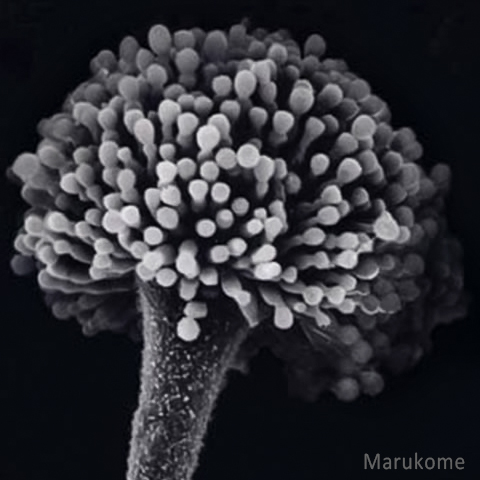
Scanning Electron Micrograph of the mould Aspergillus oryzae
Shio koji (塩麹) is made by taking the fermentation process further into a secondary liquid salt stage (water and salt is added to the koji - in Japanese, shio means "salt"). This is similar to the moromi stage in the making of soy sauce (see my soy sauce making Part 1; and Part 2). I discovered some time ago, the Japanese technique of marinating meat with shio koji to flavour and tenderize it.
Bringing koji into a salt water stage essentially halts further fungal growth but the amylolytic enyzmes already produced will further act on remaining starches during this wet stage (the koji becomes sweeter). The saline environment encourages the growth of naturally occurring microbes such as halotolerant/halophillic yeasts to thrive, grow and produce metabolites some of which contribute to umami. Since rice koji only has a small content of protein and fats, its organoleptic characteristic after fermentation is only a sweet profile (unlike other substrates which contain more protein e.g. soy bean; barley). But, when shio koji is introduced to meat, the proteolytic enzymes which may have been produced by the fungus prior to the saline koji stage, tenderize the meat by breaking down protein tissue. Fats are also broken down (and presumably change in flavour) by fungal lipases in the rice koji.
Thus, the utility of shio koji lies in the presence of umami metabolites, simple and complex sugars (sweetness) contained within, and the potential for tenderization via protein breakdown.
The last utility is the one which I am least confident about because the synthesis of enzymes by microbes is most usually under induction control i.e. enzymes are produced by microbes when a substrate which it can act upon is present in their environment (microbes have evolved to be very physiologically efficient). There being little of no protein or fat present in rice, there should be little induction for the synthesis of proteases and lipases. However, more rarely, there is such a thing as constitutive enzymes: These are produced irrespective of the presence of an appropriate substrate, and are also not subject to repression control. Without knowing the specific strain of A. oryzae used by the Rice Culture company, the supplier of my Shio Koji kit, I would not know if it is one selected for proteases and lipases besides amylases. For meat marination, an A. oryzae selected for soy sauce production is probably better as it should have proteases since soybean contain proteins.
Nevertheless, I thought I would give shio koji marination a try. Here's what happened:
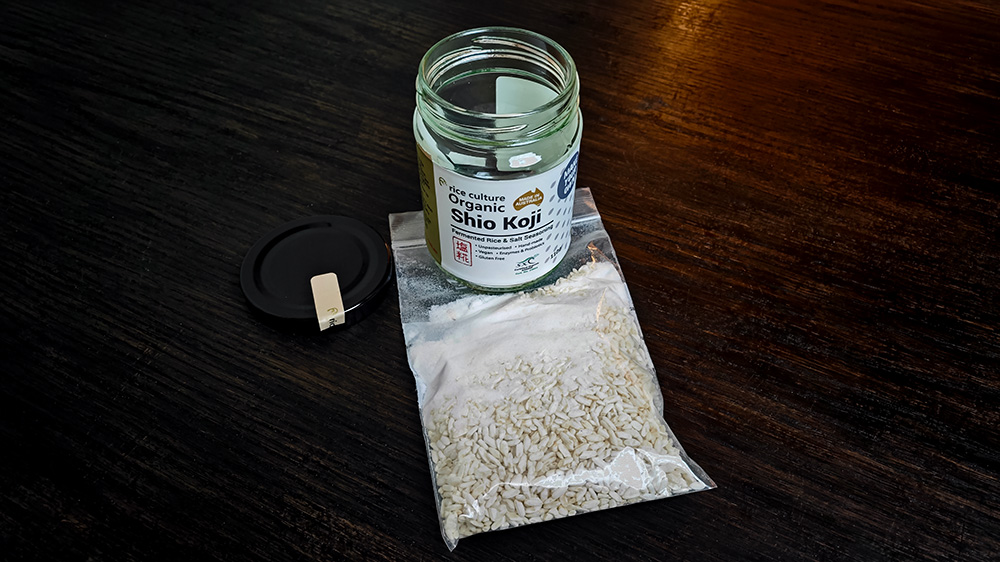
Shio koji kits can
be bought online from
Rice Culture located in the
Gold Coast, Queensland.
I have also previously bought a starter culture for making soy
sauce from them.
Or you can choose to make it yourself (see below) if you have rice koji (also available from Rice Culture)
In a hot water washed bottle, add -
- 100 g rice koji.
- 150 g water
-
25 g sea salt (this is 20%w/w)
(you can raise this higher if you wish)
Do not use iodized salt.
-
Mix well and set aside in a warm corner of your kitchen for
at least 1 week.
Mix the contents of your ferment regularly by up turning the bottle.
It is ready for use after a week although you can continue the process for longer.
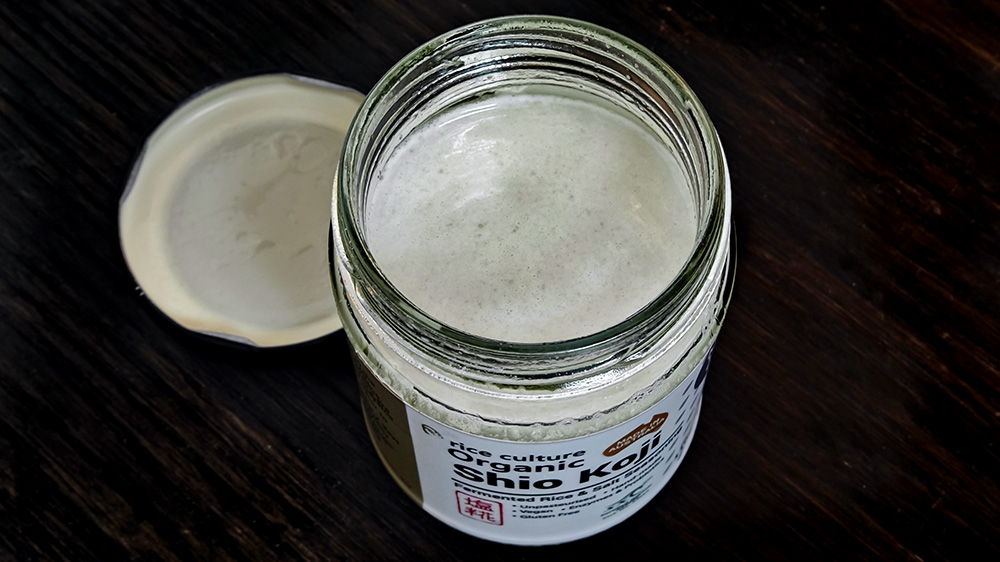
Day 0: Shio koji
kit after
the addition of a measured quantity of water.
The bottle was then set aside in a warm corner of my kitchen for
7 days before use.
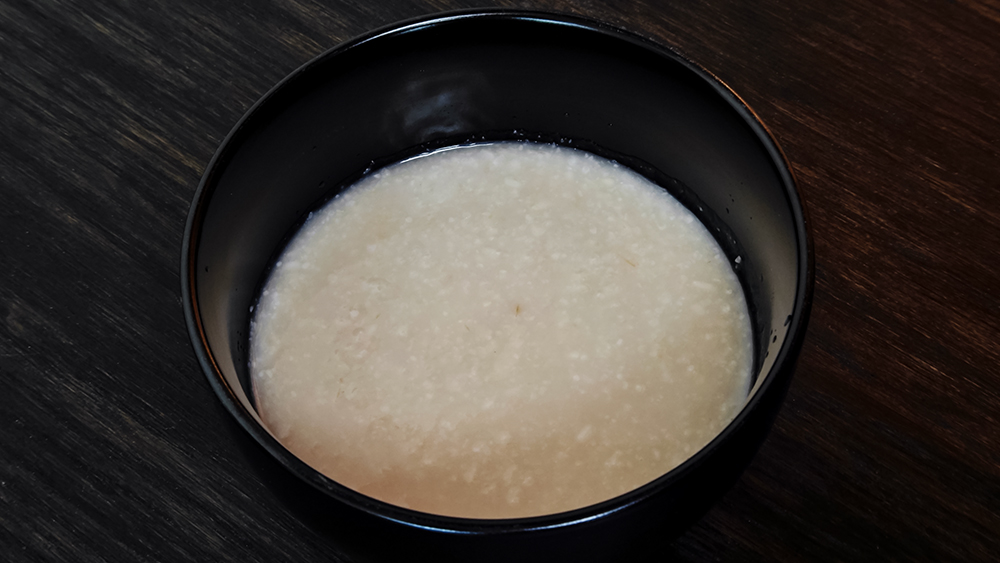
Shio Koji at Day 7 and ready for use.
The bottle content had turned into a fluid liquid (the rice
granules had largely broken down) and there is an aroma.
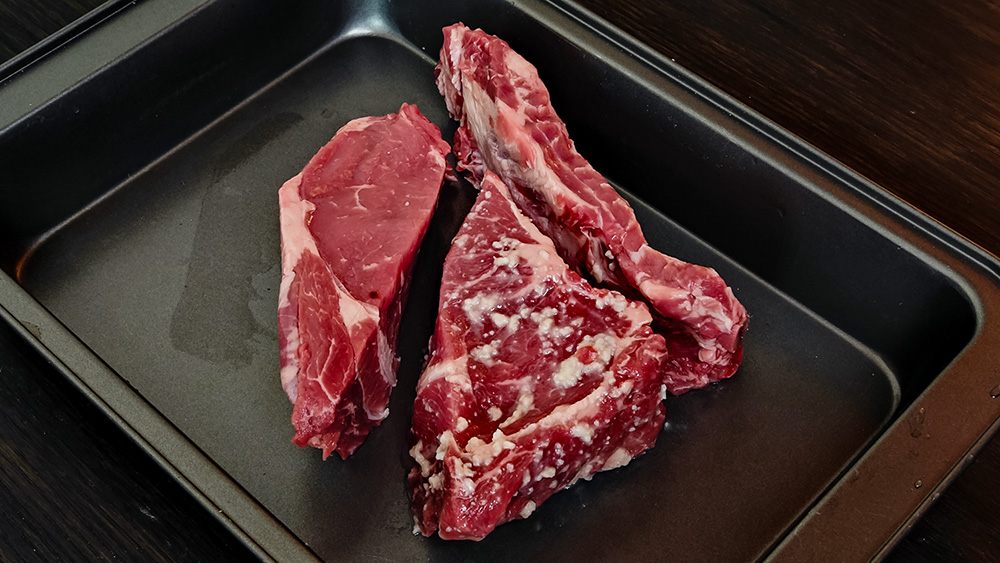
A Beef Rib
Steak-on-the-Bone with bone removed and steak cut into two
portions
The portion on the left was untreated while the portion of the
right was coated with Shio Koji.
Both portions were left overnight in a refrigerator before
cooking.
Marination
-
The test item was a Ribsteak-on-the-Bone.
-
Firstly, the rib bone was removed and the freed steak was cut in
two diagonally to have as equal a distribution of tissue type as
possible.
-
One portion of the steak was left natural as the "control".
-
The other portion was liberally coated with shio koji.
-
Both portions were put into plastic bags and then left in the
refrigerator overnight.
- The following day, the steaks were pan fried to medium rare.
Pan Frying
-
The shio koji treated steak portion was cleaned up
before any frying was done (any rice granules present were
brushed off). This proved a bit difficult to do and so
I quickly ran the steak under a running tap just swiftly
enough to rid the portion of koji debris.
-
The "control" portions were pan fried first so as not to
have any carry over of shio koji juices (actual or
induced meat juices) carry over to the untreated portion.
-
Both treated and untreated portions of steak were seared
over high heat until
brown and slightly charred.
-
The steak portions were removed from the pan when their
internal temperatures were around 42 - 45oC but
already browned on the outside.
-
The steaks were placed in an oven at 100oC and held until
internal temperatures reached 52 - 55oC.
-
The steak portions were allowed to cool down before slicing
as shown below.
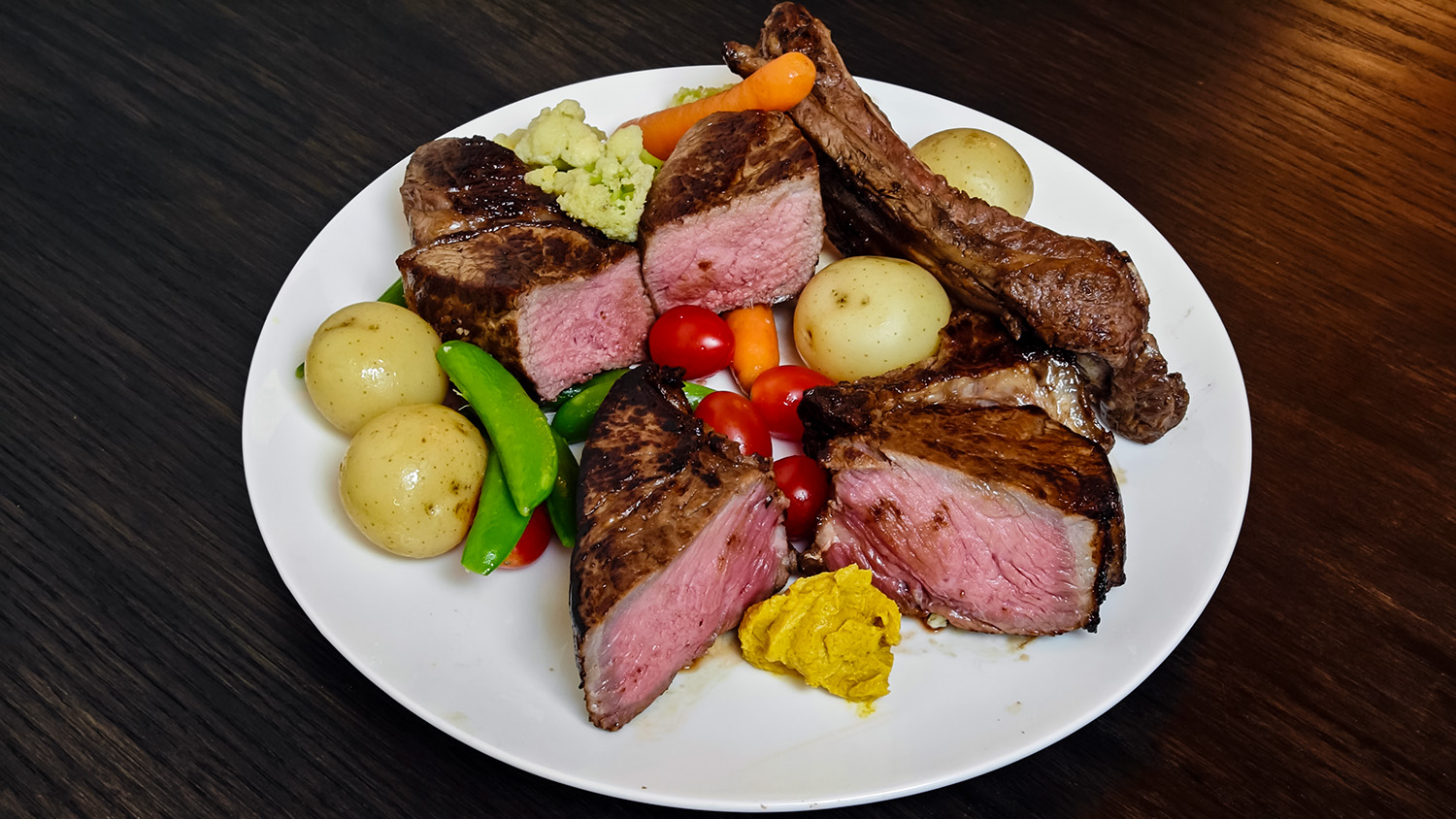
The ribsteak cooked and plated
to show the treated and untreated portions after slicing.
The two pieces at the top are the "control" (untreated).
The lower two pieces are the shio koji treated portions.
The accompaniments were buttered Baby Potatoes, Sugar Peas,
Sweet Solanato Tomatoes, Baby
Carrots, and Cauliflower Florets.
The yellow pat was Hot English Mustard.
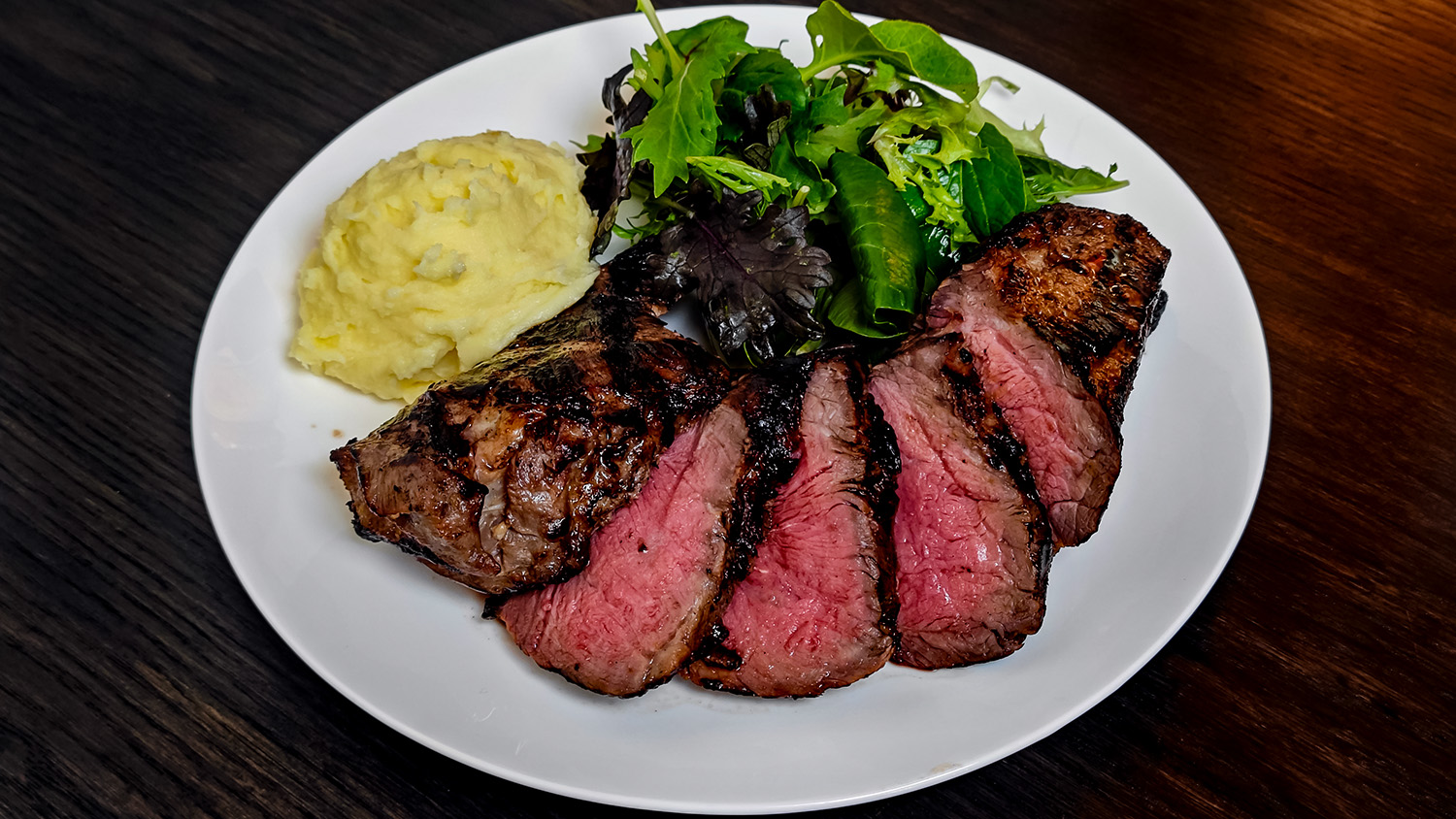
Second shio koji
test with a sirloin steak BBQ grilled/oven baked to rare-medium
rare.
The accompaniments were pomme
purée and mixed salad greens.
Verdict
-
The Koji treated steak browned much faster than the
control. This is probably due to the presence of sugars in
the koji (breakdown products from starch). This
tendency to quick;y brown is also why koji debris
should be cleaned off your steak before frying - it burns.
-
The shio koji treated steak portions were saltier as
might be predicted because shio koji is very salty.
-
Taste-wise, I could not say that there was a noticeable
difference in taste imparted by the shio koji - I did
not detect any extra sweetness. The difference in taste is
due to the salt in koji and possibly the presence of
umami compounds (microbial metabolites) in it too.
-
BUT, I could discern that the koji treat steak was
both more tender (only slightly more so) and juicier than
the control steak. The juiciness is probably due to the meat
texture having changed and able to retain water under the
cooking conditions used.
-
2nd Test: The next day, I put the koji to a
more difficult test by marinating (24 hours) a piece of
sirloin steak. The latter is a tougher cut than
previous day's ribsteak. The sirloin was grilled/oven baked
to rare-medium rare. Just as the in the case with the
ribsteak, the main difference at first tasting after cooking
was a noticeable increased tastiness from koji
treatment. BUT, what I didn't report prevoiusly and again
observed today, was that I noticed more tenderness
develop in the steaks after they were left on the plate for
some 30 minutes (I ate the steaks in two goes). The only
way I can explain this is that proteolysis (meat tissue
breakdown) from koji enzymes continued to work in the
residual heat of the steaks after cooking (they were cooked
to an initial internal temperature of 50 - 55oC).
Thus, while at first bite after cooking, there didn't appear
to be much difference in tenderness with koji
treatment, there appeared to be a detectable difference
after the steaks were left some time on the plate. This also
makes a statement about whether sufficient enzymatic
transformation of meat in steaks by koji occurs at
refrigerator temperatures - enzymes need kinetic energy
[heat] to work). The caveat to this is that
for my hypothesized continued meat tissue breakdown after
cooking to occur, the internal temperature of your cooked
steaks should not be much higher than 60 - 70oC,
otherwise, the relevant enzymes will be denatured (and cease
to work).
-
So, is it worthwhile to make shio koji and marinate steak
with it?
If you have time and no trouble in finding/making the koji, it is probably worth doing. In my case, not only did I have time and was able to find a shio koji kit, my epicuriousity led me to do it.
Ganbatte 頑張って
All my cooking (some without recipes) can be found here (click on each photo to go to that dish's page):
http://clemkuek.com/photoalbum/photo696.html
Video presentations can be found here:
03 and
05 March
2026
Created by Clem Kuek
