Clem's Pastrami
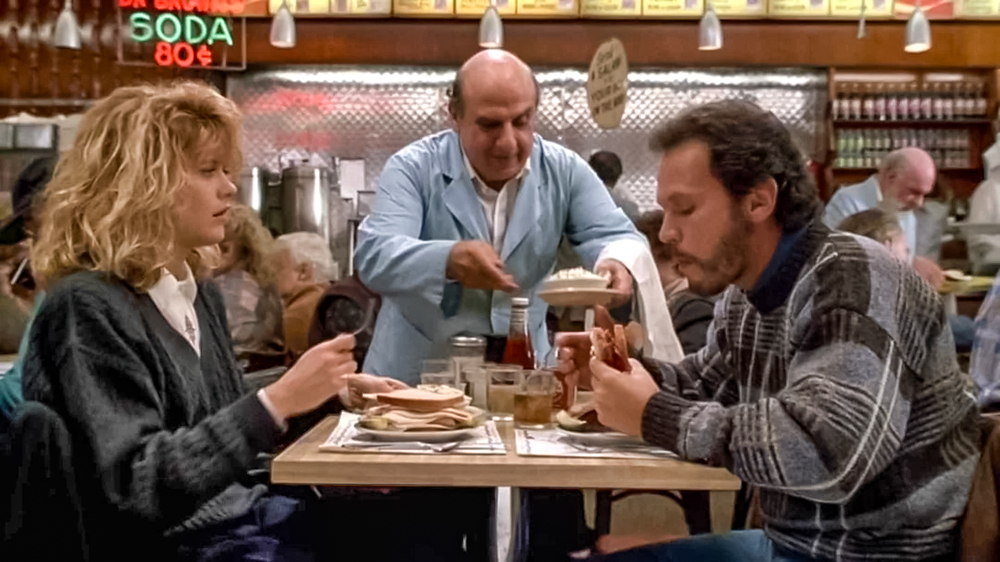
The Katz's Delicatessen
scene from "When Sally Met Harry"
Pastrami is cured beef, usually brisket (Katz's uses Beef Navel (also known as Beef Belly or Plate). It is firstly brined with spices, smoked and then usually steamed.
The first brining stage is similar to the way corned beef is
made. Thus, one can make both corned beef and pastrami at
the same time as I did this time in the following manner:
GENERAL PRECAUTION
You
are making a food product.
Exercise maximum hygiene/sanitation in all your procedures and
equipment used.
Method
Firstly, obtain beef brisket of an amount suitable for your needs.
Prepare the brining solution (for each litre)
-
175 g table salt
-
150 g brown sugar
-
2.5 g No. 1 Pink Curing Salt (Prague Powder)
Note: This quantity is less than is typically used and will result in less of a typical ruddy red look of cured meats.
To get a redder look, use 3.2 g per litre of brine (per J. Weissman)
No. 1 Pink Curing Salt is pink in color so that it is not mistaken for table salt (it is NOT Himalayan PINK salt).
It comprises 6.25% Sodium Nitrite and 93.75% table salt (NaCl).
The US FDA recommendation for dosage of No.1 Pink Curing Salt is no more than 3.2 g for each kilogram of meat to be cured (see below for risk).
The nitrite is antimicrobial and helps preserve processed foods. Red meat is red because oxygen binds with the pigment myoglobin in meats. This binding is temporary and when the oxygen is lost, meat turns grey. Nitrite is an alternate to oxygen as a myoglobin binder but the bonds made are more stable. This is why nitrited meats remain that ruddy colour - such as in corned beef when nitrite is added.
Be aware that nitrites when consumed has been shown to cause cancer - in mice. However, curing salt is used routinely in commercially processed meats such as bacon, hams and corned beef. As with everything else, eat these in moderation.
Do note that the compounds of concern - nitrosoamines, form from nitrites in meat at cooking temperatures above 130oC. Since corned beef and pastrami processing usually involve temperatures below 130oC, it can be said that consumption of these meat products is less of a worry if any.
-
Spices (your choice of blend and now much):
Roughly grind-
2 tablespoons black peppercorns,
-
1 tablespoon of mustard seeds yellow or black), and
-
1 tablespoon coriander seeds.
Reserve a tablespoon of this blend for use in cooking later.
-
-
Add the sugar, salt and ground spices into 1 litre of water.
-
Add 6 crushed bay leaves, and 1 teaspoon of allspice powder.
-
Boil the mix and then leave it to cool to room temperature.
Brining
-
Trim the beef brisket to remove silverskin and excess fat.
-
Place the beef into a suitably-sized container.
-
Add enough cooled brining solution to completely immerse the beef.
-
Place in a refrigerator and allow the beef to cure for 6 -10 days (I brined for 6 days).
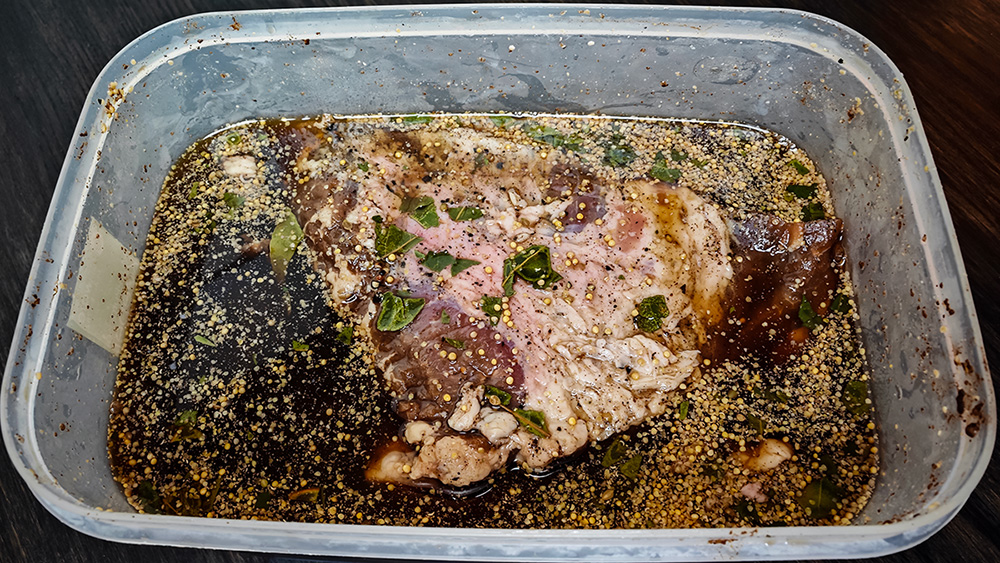
Beef brisket (cut
into 2 pieces with the tip portion showing) after brining for 6
days
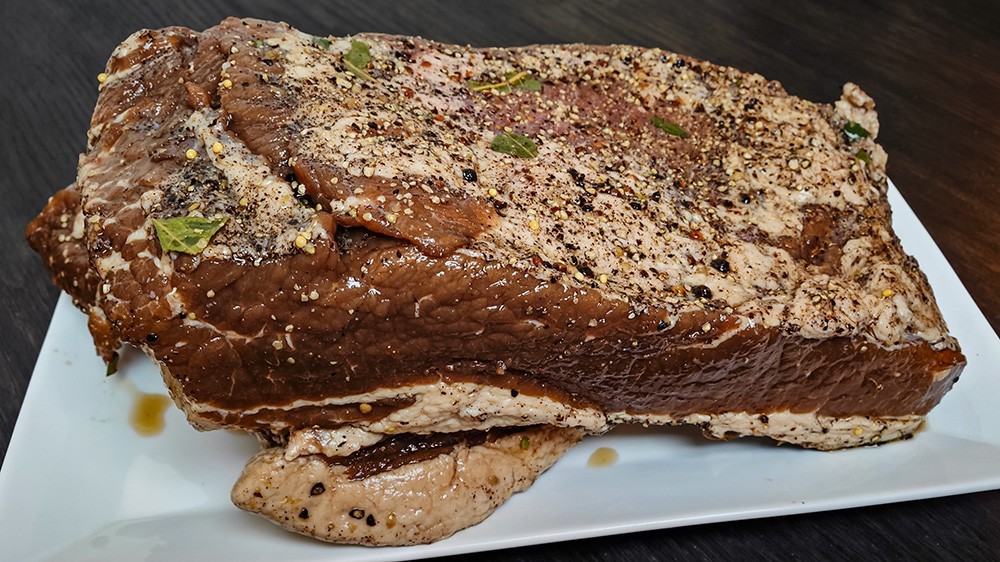
The brisket (flat portion
lying on top of the tip end) out of the brine
The remaining brisket portion was soaked in fresh water (with at least one change) overnight in a refrigerator to desalinate the meat (the corned beef did not need so much desalination as it was simmer boiled in excess water for some 3 hours).
Remove the brisket from the water and surface dry it but keep it moist enough for the next step of applying the pastrami rub. The rub is made from (in proportion):
- 2 tablespoons of whole black peppercorns
- 1 tablespoon of coarsely ground black pepper
- 1 tablespoon of whole coriander seeds
- 1 tablespoon of coriander powder
- 1 tablespoon of brown sugar
- 1 tablespoon of sweet paprika
- 2 teaspoons of garlic powder
- 2 teaspoons of onion powder
- 1/2 teaspoon of whole Yellow Mustard seeds
-
1/2 teaspoon of mustard powder
(or a squirt of prepared mustard).
Apply this rub all over the brisket and then hot smoke it at 100 - 110oC (indirect heat) until a brown crust (called "the bark") forms and internal temperature of the brisket reaches 71oC of thereabouts. I used a Weber Kettle BBQ and charcoal for the hot smoking step. Smoke came from setting woodchips (Cherry and Hickory) over the hot charcoal.
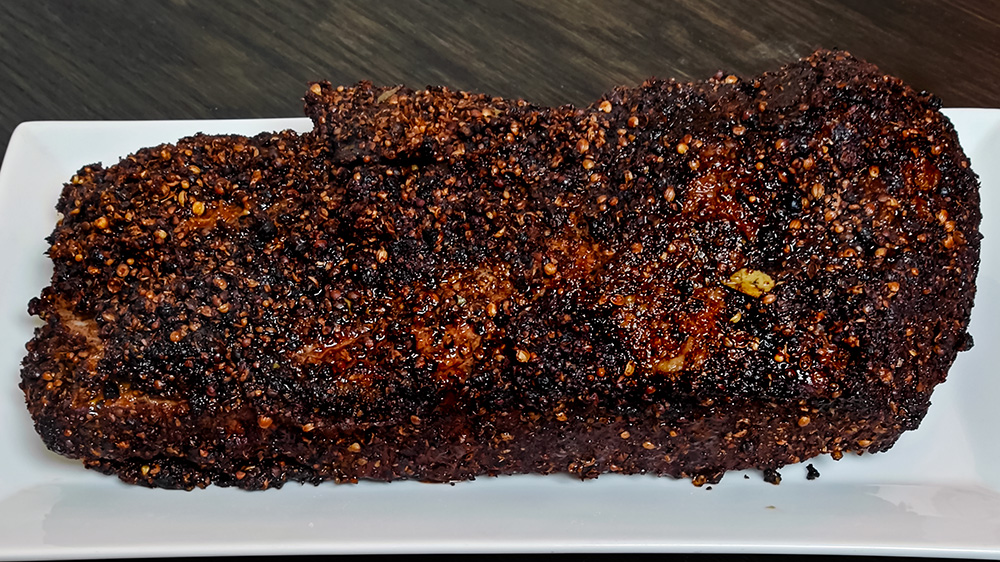
The brisket at the end of 6
h hot smoking and before the "Texas Crutch".
Internal temperature of the brisket has come up to around 60oC
at the end of hot smoking.
-
After hot smoking, wrap the whole brisket in aluminium foil
(this method is called the "Texas Crutch") and then either continue cooking in the smoker, or cook in an
oven. Either way, cook until the internal temperature of the
brisket reaches 95oC.
- You are now done cooking. Let the meat cool down before slicing as it will be firmer for good slicing then.
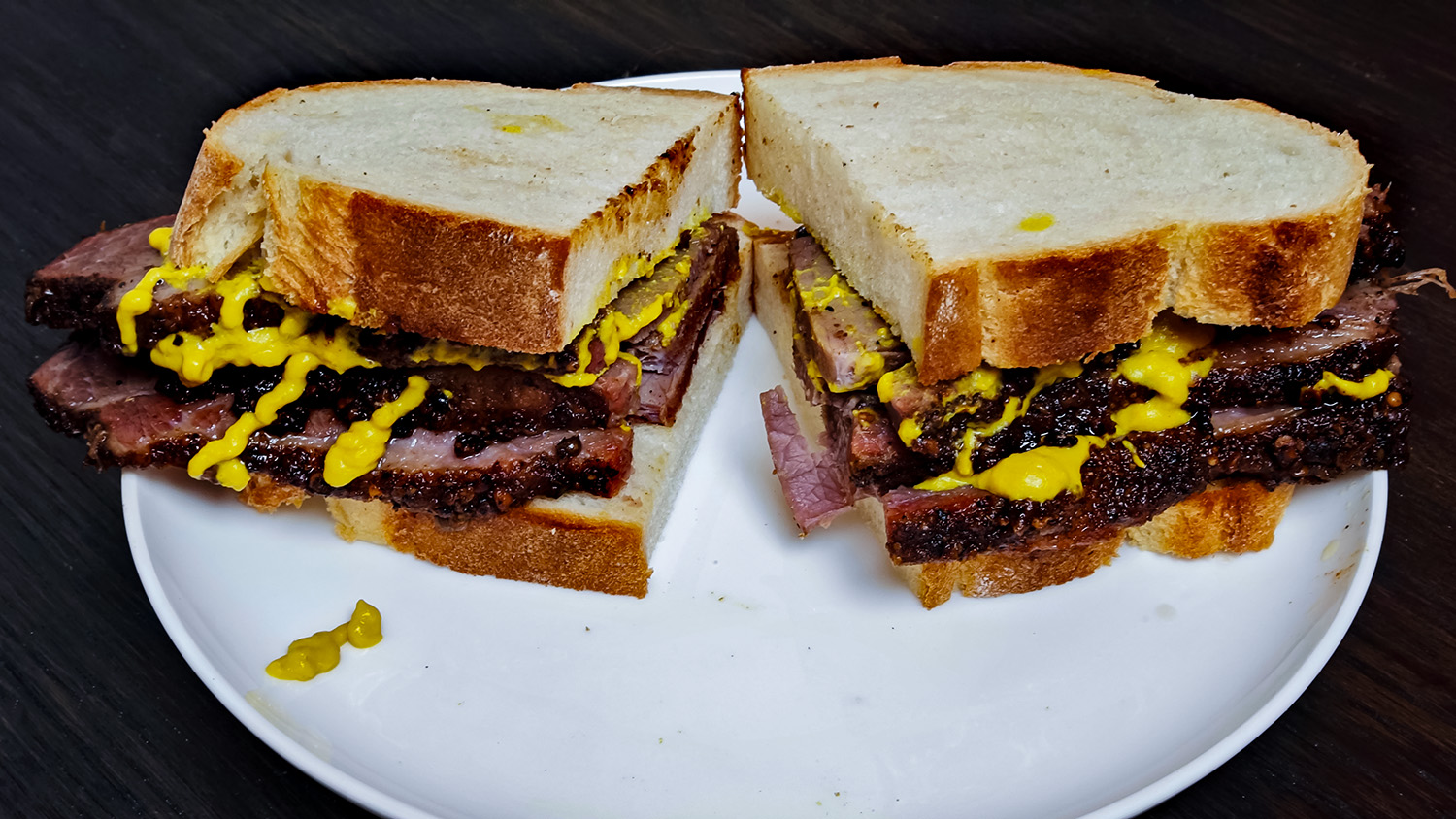
My effort served ala Katz's Delicatessen Pastrami
on Rye.
(it is thick sliced pastrami with mustard [if requested]
in between 2 pieces of rye bread)
All my cooking (some without recipes) can be found here (click on each photo to go to that dish's page):
http://clemkuek.com/photoalbum/photo696.html
Video presentations can be found here:
21
February
2026
Created by Clem Kuek
