Clem's Tau Eu Bak (Soy Sauce Slow Braised Pork Belly)
Tau Eu Bak is the name of a meat dish in the Chinese Hokkien dialect (some call the dialects languages). Tau Eu means "soy sauce" and Bak means meat although this dish is mostly made with pork (we also see chicken and duck versions).
Cooking this dish is a bit strange for me because I rarely use pork in my cooking. I would use it in soups sometimes but certainly not fatty pork belly as is de rigueur for this dish. I think this because I didn't much care for soy sauce pork dishes when growing up. Further, pork was ruled out of dishes cooked in my early decades in Australia because the pork available was invariably gamey. I think it was only after the arrival of a wave of Asian immigrants especially the Vietnamese in the late 70s and early 80s that Asian butcheries began to appear and these would sell pork that were not objectionable to oriental noses and taste buds. I now cook pork dishes when I have an urge for a certain organoleptic/culinary memory. For a couple of weeks now, I imagined how I would cook my first Soy Sauce Slow Braised Pork belly. After some research and delving into my organoleptic memory (remembering what this dish tasted like and therefore what flavour ingredients would have been added), this was how I made the dish for dinner tonight:
INGREDIENTS
- Around 1
kg of pork belly
Choose a portion with the skin on (pass the skin over a fire if it is more hirsute than you would wish).
The better belly would that which have roughly equal portions of fat to meat banding (or any variation of this to your liking).
You can choose other pork cuts of your preference if you are averse to fat.
Shoulder is another cut that is often used.
- 20 - 30 g
rock sugar (or to taste)
Use brown sugar or plain sugar if you only have those available.
- A few tablespoons
of Dark Soy Sauce.
- A few tablespoons
of Light Soy Sauce (usually less than the dark variety).
- 1 - 2 inches root ginger
(sliced).
- 4 - 5 cloves of
garlic (smashed).
- 2 or 3 pieces of
star anise.
- 5 - 6 stalks (only
white bottom part required) of spring onions.
- 4 - 5 pieces of
cloves.
- 1 small quill of
cinnamon.
- 1 teaspoon of whole
black pepper.
- 1 - 2 teaspoons of
5-Spice powder.
See how I made mine here).
- Salt to taste.
- Optional: Some fresh chilli to taste; some hard boiled eggs; MSG to taste.
METHOD
-
Cut the pork
into large rectangular or cube pieces.
-
Blanch the
pork belly.
This is to "deodorize" the pork and to flocculate protein scum (air bubbles from boiling creates foam and when proteins coagulate around the bubbles they are taken out of solution when they rise to the top of the boil - this is called protein fractionation).
To gently boiling water in a saucepan, add some salt and a few slices of ginger.
Then add the pork belly pieces.
Let the saucepan gently boil for less than 5 minutes.
Now drain the pork in a colander and flush them with running water to remove any adhering proteinaceous scum.
Set aside the pork pieces to surface dry.
Drying is important because you will otherwise get a lot of splattering during the frying later).
-
Add a couple tablespoons of
cooking oil is a suitably sized saucepan (I used a Dutch
Oven) and add the rock sugar to fry.
Once the sugar begins to melt, stir constantly to avoid the sugar burning.
What you want to achieve in this stage is caramelized sugar.
Stir and fry until you see the sugar turn into a golden brown colour.
Do not over fry as the sugar and end up with bitter compounds.
-
When the colour of the sugar
is right, add all the pork to the fry and stir well.
-
Add the star anise, cloves,
black pepper, garlic, and 5-Spice powder and fry for another
few minutes.
-
Now add the dark and light
Soy Sauce and continue frying.
-
Now you can add enough water
to just cover the pork.
Add the Spring Onions.
-
Cover the saucepan and cook
on a very low simmer for some two hours or until the pork is
tender
to your liking and the fat is
gelatinous.
The key to cooking the pork belly is exposure to low, moist heat (keep the meat under fluid) for an extended period.
-
If the gravy looks too fluid,
you can cook some of the last stage with the cover of the
saucepan slightly ajar to allow some water to evaporate.
On the other hand if the saucepan looks too dry, add water to it.
What you want is enough gravy to your liking.
-
Add the chilli in the last
hour or so of the cook so that it retains its shape for
presentation purposes (or earlier if this does not matter).
It is also at this stage that you can add some hard boiled eggs.
You will need to turn these over a few times so that all the egg surfaces are browned by the Soy Sauce in the gravy.
-
When the pork is ready to
your liking make a taste test and add condiments to taste.
When done, you should have a dark coloured stew with a sweetish and slightly sticky gravy. Note that the dark colour will depend on how well you caramelized the sugar and what kind of dark Soy Sauce you chose.
ENJOY!
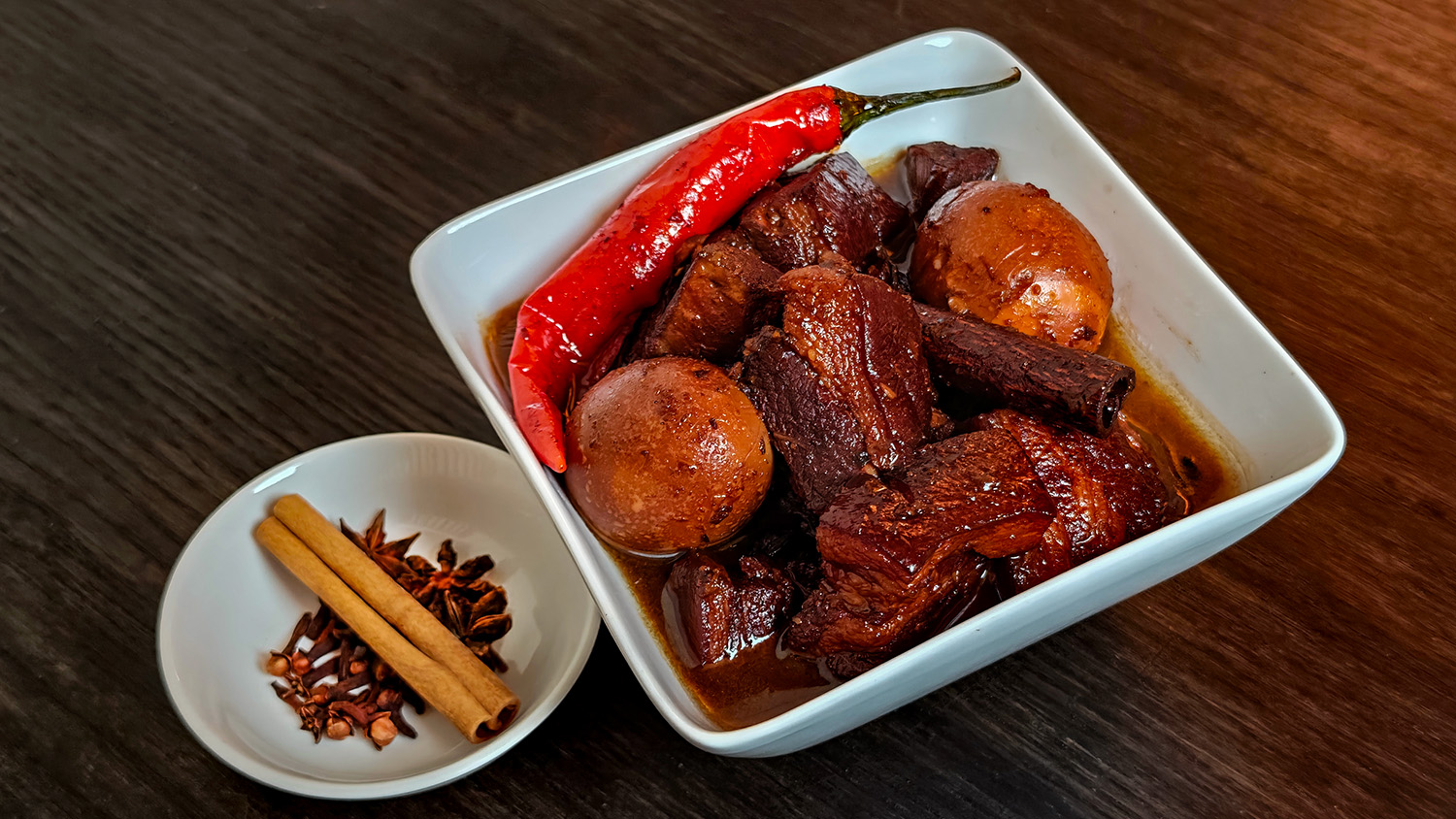
Clem's Soy Sauce Slow
Braised Pork Belly
04 June
2026
Created by Clem Kuek
